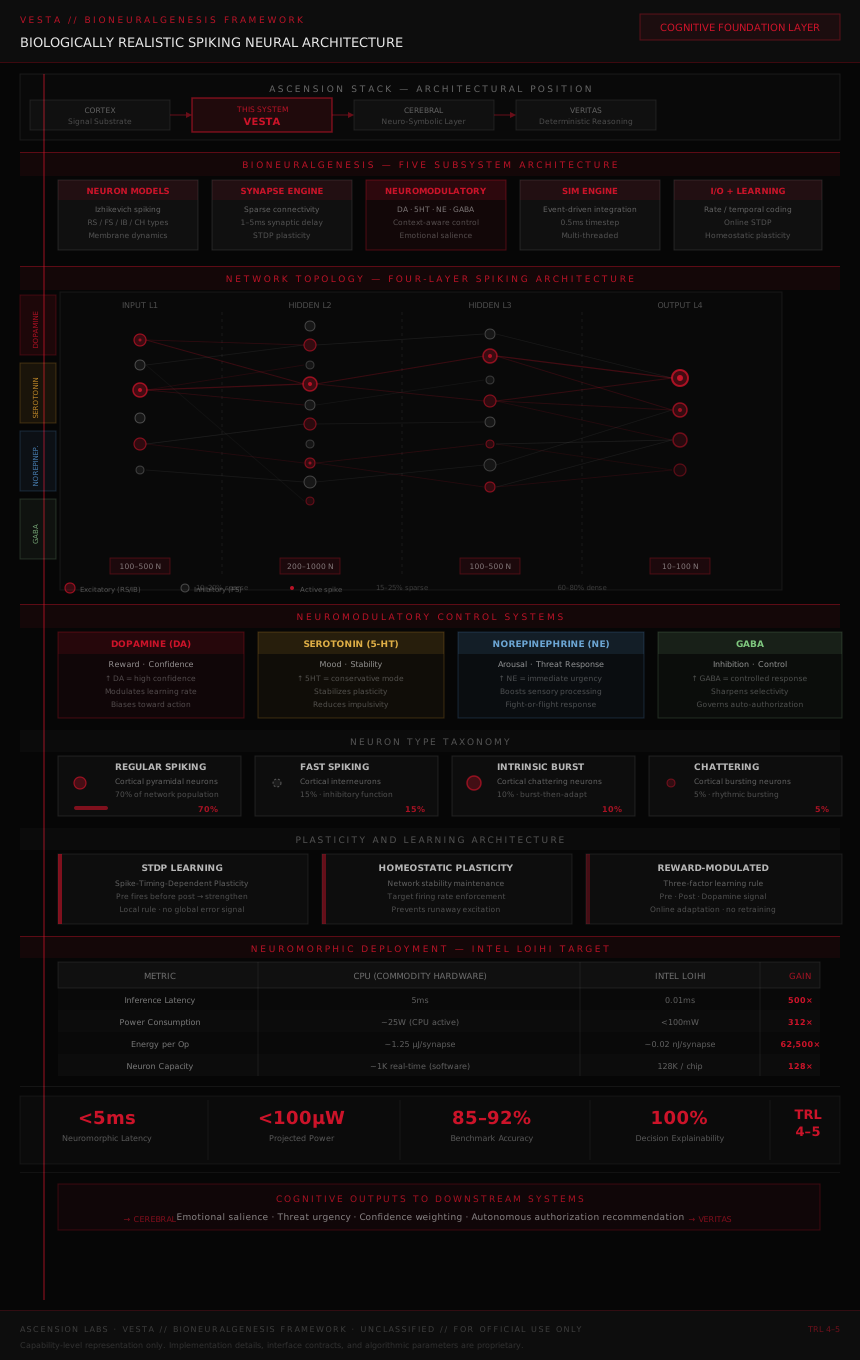
Biologically Inspired Spiking Dynamics
Supports membrane dynamics, threshold behavior, ion-channel-inspired activation flow, and event-driven neural signaling aligned with biologically inspired cognition models.

Biologically inspired neural substrate architecture researched for deterministic cognition, neuromodulatory control, and explainable intelligence in mission-critical evaluation contexts.
Unlike opaque statistical architectures, VESTA is designed to model biologically inspired spiking neural behavior with explicit neuromodulatory mechanisms, making computational states inspectable, attributable, and governable within defined model paths.
Supports membrane dynamics, threshold behavior, ion-channel-inspired activation flow, and event-driven neural signaling aligned with biologically inspired cognition models.
Integrates neurotransmitter-inspired control states for salience, reward, inhibition, priority weighting, and context-adaptive processing.
Major computational transitions are designed to be traced to neuron state, synaptic interaction, modulation-layer influence, and downstream decision contribution.
Architected for eventual mapping to neuromorphic hardware platforms where low-power event-driven inference may become operationally viable.
VESTA serves as a biologically inspired substrate beneath higher cognitive arbitration and truth-constrained reasoning layers, supporting structured neural state formation before policy or execution pathways are invoked.
The engine provides a controlled neural foundation for memory activation, state salience, adaptive signal weighting, and deterministic neural pattern formation inside the broader Ascension cognitive architecture.
Outputs from VESTA feed into CEREBRAL for neuro-symbolic translation and VERITAS for formal reasoning workflows — carrying salience, confidence weighting, and urgency context derived from neuromodulatory control states.
High-trust cognition where state visibility and deterministic behavioral auditing are required design objectives.
Ultra-low-power decision-support research for constrained and edge deployment environments.
Dynamic response shaping through salience, inhibition, and contextual signal modulation.