Formal Logic Substrate (GPX)
Built on a Guided Provable eXecution (GPX) substrate that constrains governed inference within a formal logical calculus. Conclusions are derived from stated premises rather than unsupported stochastic interpolation.

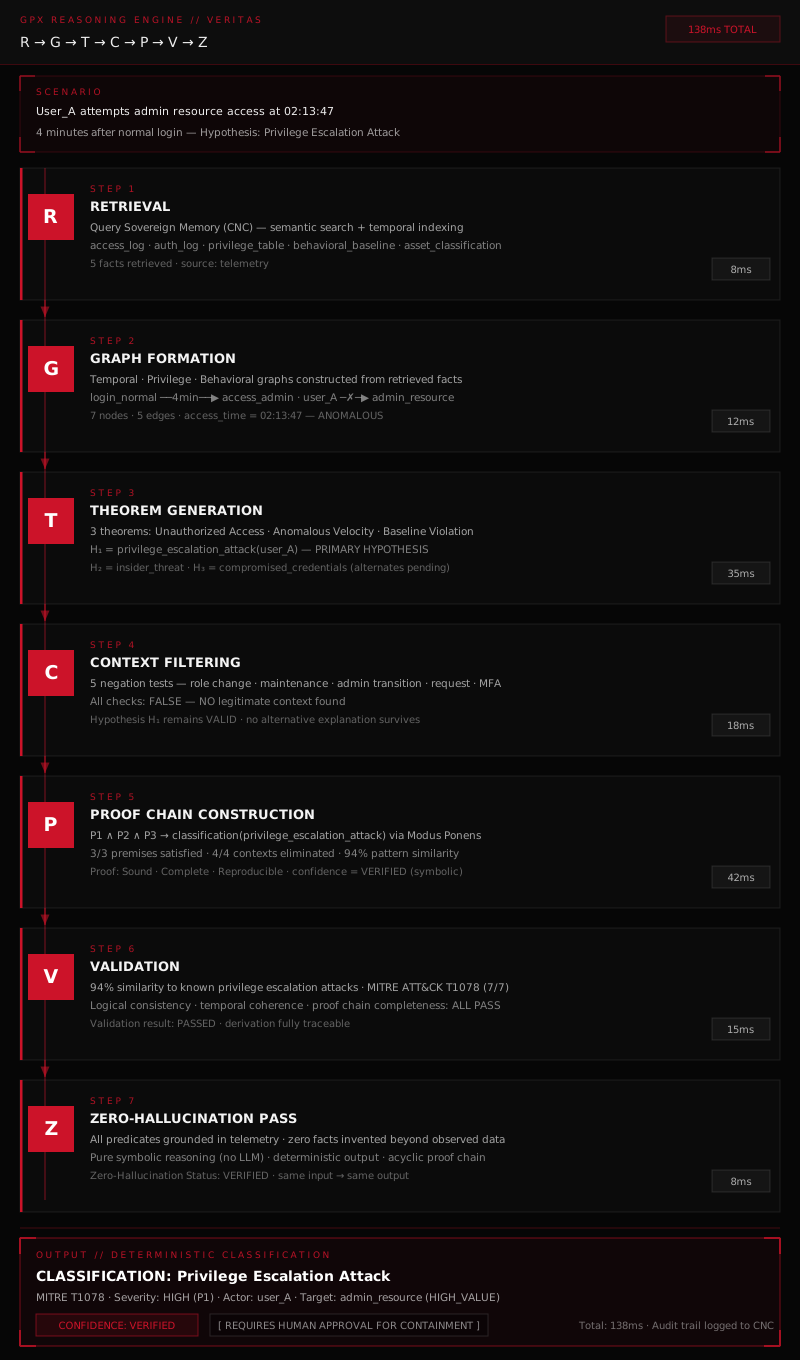
The logical backbone of the CAI stack — a formal reasoning engine where governed inference chains are mathematically constrained, auditable from premise to conclusion, and designed to resist stochastic drift. Governed conclusions are designed to be derived from stated premises and traceable proof paths.
Statistical approximation is acceptable in many domains. In high-consequence autonomous systems, it requires deterministic control boundaries. VERITAS is engineered to reduce inference drift by making governed conclusions formally derivable, reasoning paths inspectable, and unsupported stochastic conclusions constrained within GPX-controlled decision paths.
Built on a Guided Provable eXecution (GPX) substrate that constrains governed inference within a formal logical calculus. Conclusions are derived from stated premises rather than unsupported stochastic interpolation.
Reasoning steps are represented as nodes in an auditable directed graph. Derivation paths from input premise to governed conclusion are designed to be preserved, traversable, and exportable for review.
Active contradiction monitoring across live reasoning threads. Conflicting premises are flagged, isolated, and surfaced to CAI before governed downstream action is permitted, reducing the risk of decisions built on inconsistent knowledge states.
Validated VERITAS outputs are designed to include compact proof certificates linking conclusions to authorizing premises, supporting independent review without re-executing the full inference chain.
VERITAS receives structured signal representations from CORTEX and symbolic knowledge constructs from CEREBRAL, applying formal inference to convert structured inputs into proof-traceable conclusions for governed decision support.
Maintains concurrent inference threads for active evaluation scenarios, detecting contradictions across threads, managing premise confidence weighting, and issuing conclusions with explicit confidence bounds and derivation certificates.
VERITAS conclusions are passed to CERTUS for governance evaluation and to CAI for cognitive state integration. Validated conclusions are designed to include machine-readable proof bundles supporting downstream verification.
Proof-traceable reasoning for environments where decision auditability is a legal or operational requirement.
Contradiction detection and logic integrity verification in adversarial information environments.
Formal reasoning output for programs requiring demonstrable explainability under regulated AI assurance and acquisition frameworks.