
RESEARCH BRIEF // AL-MISSION-2026
Joint Decision
Superiority
Cybernetic Autonomous Intelligence architectures are being developed to compress decision cycles by supporting faster analysis, validation, and escalation control while preserving human authority. Through deterministic reasoning, policy-governed execution, and cryptographic traceability, Ascension Labs research advances the foundation for decision superiority in contested, denied, degraded, and disconnected environments.
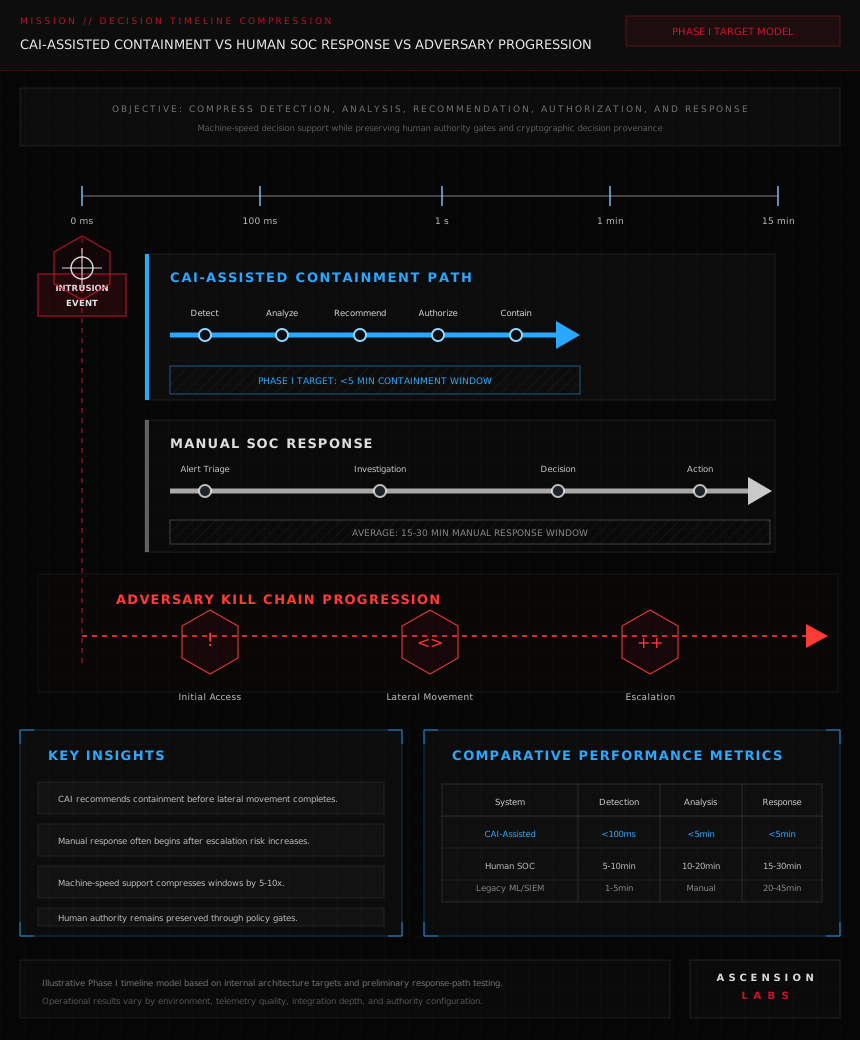
Compressed Decision Cycles
AI-enabled adversaries can accelerate targeting, deception, and response workflows toward sub-second operational tempos. Human response cycles alone may struggle to match the speed of automated conflict, requiring governed systems that support faster detection, validation, escalation, and response coordination.
Stochastic Systems Require Governed Decision Boundaries
Commercial large language models can produce probabilistic outputs that vary by prompt, context, model version, retrieval state, and configuration. In high-consequence environments, non-deterministic AI decision support requires deterministic control layers, human authority thresholds, and traceable execution boundaries.
Cloud Dependency Can Become a Single Point of Failure
Intelligence systems that require continuous connectivity may be degraded or unavailable in contested electromagnetic environments, denied network conditions, or air-gapped deployment profiles. For high-assurance operations, unnecessary dependency becomes vulnerability.
To research, prototype, and evaluate governed autonomous systems that synthesize multi-domain intelligence across physical and virtual environments — supporting policy-constrained defensive response pathways under human-defined authority, with cryptographic provenance for governed decision outputs.
COMPRESS THE DECISION LOOP
Evaluate sub-2ms core reasoning targets for edge-capable autonomous decision support without cloud dependency at the governed decision-control layer. CAI’s 1.16ms latency figure reflects internally observed benchmark performance measured at the core reasoning layer, not the interface.
REDUCE HALLUCINATION RISK THROUGH GOVERNED REASONING
Use Guided Provable eXecution (GPX) to support deterministic reasoning and traceable output generation within governed decision paths. No unauthorized execution paths have been observed across mapped Phase I prototype test scenarios.
PRESERVE HUMAN COMMAND AUTHORITY
Maintain legal accountability and human command authority through CERTUS — cryptographic escalation controls designed to enforce authority chains below the prompt layer through policy-bound architecture and hardware-aware control design.
ADVANCE MULTI-DOMAIN INTELLIGENCE FUSION
Develop multi-domain intelligence fusion across defined disciplines — including HUMINT, SIGINT, CYBINT, GEOINT, DARKINT, and AICINT — toward a common operating picture with confidence weighting and source provenance.
EVALUATE OPERATION IN DENIED ENVIRONMENTS
Evaluate local operational capability in air-gapped, contested, and denied-network evaluation profiles. A 30-day internal isolation test observed no capability degradation across the defined local subsystem functionality profile.
Sovereignty
Authority structures remain under human command. CAI is designed to operate within the authorization envelope defined by its operators and governed by CERTUS-controlled execution boundaries.
Determinism
Governed decision-layer outputs are designed to be reproducible through traceable GPX-controlled execution paths.
Speed
1.16ms internally observed core reasoning latency under controlled benchmark conditions. The governed decision-control layer is designed to operate without cloud dependency or external inference chains.
Integrity
Hash-chained cryptographic audit trails are designed to trace governed decision outputs to originating inputs, rules, and execution paths.
Resilience
Local capability evaluated for air-gapped, electromagnetic-contested, and network-denied deployment profiles.
Precision
Escalation responses are constrained by policy gates and authority thresholds — designed for bounded, traceable action rather than unrestricted extrapolation.
Autonomy is not granted. It is earned through demonstrated
determinism, observed escalation integrity, and accountable
authority chains.
Systems within the CAI architecture are designed to operate inside
authority structures defined by their operators. CERTUS is
designed to enforce these constraints through policy-bound
execution, hardware-aware governance, and real-time authorization
gates.
Human command authority is not a feature. It is an architectural
invariant.
Formal technical briefings available upon request.